

How To Add Explosion Animations In Unity 2d
Frazzle Smoke from a Vehicle
A Simple Explosion
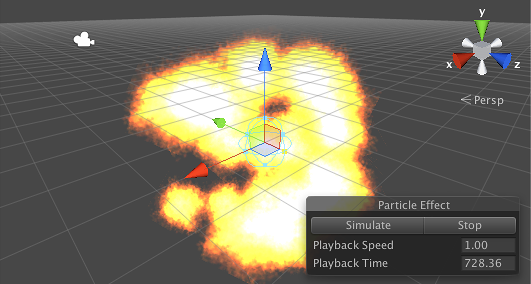
You can use a particle organization to create a convincing explosion but the dynamics are perhaps a little more complicated than they seem at beginning. At its core, an explosion is only an outward burst of particles but there are a few simple modifications you can apply to make it look much more realistic.
Timeline of a Particle
A uncomplicated explosion produces a ball of flame that expands outward rapidly in all directions. The initial flare-up has a lot of free energy and is therefore very hot (ie, bright) and moves very fast. This energy apace dissipates which results in the expansion of flame slowing down and too cooling downwardly (ie, getting less brilliant). Finally, as all the fuel is burned up, the flames will die away and presently disappear completely.
An explosion particle volition typically take a short lifetime and y'all can vary several unlike properties over that lifetime to simulate the effect. The particle will start off moving very fast but and then its speed should reduce greatly as it moves away from the centre of the explosion. As well, the color should beginning off bright merely and then darken and eventually fade to transparency. Finally, reducing the particle's size over its lifetime will give the effect of the flames dispersing equally the fuel is used up.
Implementation
Starting with the default particle system object (menu: GameObject > Create General > Particle Arrangement), go to the Shape module and set up the emitter shape to a small Sphere, say about 0.5 units in radius. The particles in the standard avails include a material chosen Burn Add which is very suitable for explosions (carte: Assets > Import Package > Particles). Yous can set this material for the arrangement using the Renderer module. With the Renderer open, yous should also disable Cast Shadows and Receive Shadows since the explosion flames are supposed to requite out light rather than receive it.
At this stage, the system looks like lots of little fireballs being thrown out from a cardinal indicate. The explosion should, of class, create a burst with lots of particles all at once. In the Emission module, yous can set the Rate value to zero and add a single Burst of particles at fourth dimension zero. The number of particles in the burst volition depend on the size and intensity you want your explosion to have only a good starting point is about l particles. With the outburst set up, the system is now starting to look much more like and explosion just it is rather slow and the flames seem to hang around for a long fourth dimension. In the Particle System module (which volition have the same name as the GameObject, eg, "Explosion"), fix both the Duration of the organisation and the Get-go Lifetime of the particles to two seconds.
You can as well employ the Size Over Lifetime module to create the result of the flames using up their fuel. Set the size curve using the "ramp downward" preset (ie, the size starts off at 100% and reduces to zero. To make the flames darken and fade, enable the Color Over Lifetime module and prepare the slope to showtime with white at the left and finish with black at the right. Since the Fire Add material uses and additive shader for rendering, the darkness of the colour property also controls the transparency of the particle; the flame's volition get fully transparent as the color fades to black. Likewise, the condiment cloth allows the brightness of particles to "add" together as they are drawn on height of each other. This helps to further heighten the impression of a bright flash at the get-go of the explosion when the particles are all shut together.
Every bit it stands, the explosion is taking shape only it looks every bit though it is happening out in space. The particles get thrown out and travel a long distance at abiding speed before fading. If your game is fix in space then this might exist the exact upshot yous want. Nevertheless, an explosion that happens in the atmosphere will be slowed and dampened past the surrounding air. Enable the Limit Velocity Over Lifetime module and set the Speed to about 3.0 and the Dampen fraction to about 0.4 and you should see the explosion lose a little strength equally it progresses.
A final thing to note is that every bit the particles move away from the middle of the explosion, their individual shapes become more recognisable. In item, seeing the particles all at the same size and with the same rotation makes it obvious that the aforementioned graphic is existence reused for each particle. A elementary way to avoid this is to add a bit of random variation to the size and rotation of the particles as they are generated. In the Particle System module at the top of the inspector, click the small pointer to the right of the Start Size and Showtime Rotation properties and gear up them both to Random Between Two Constants. For the rotation, set the ii values to 0 and 360 (ie, completely random rotation). For the size, gear up the values to 0.5 and 1.five to give some variation without the risk of having too many huge or tiny particles. You should now see that the repetition of particle graphics is now much less noticeable.
Usage
During testing, it is useful to accept the Looping holding switched on so y'all tin meet the explosion repeatedly but in the finished game, you should switch this off so the explosion happens only once. When the explosion is designed for an object that has the potential to explode (a fuel tank, say) you might want to add together the Particle System component to the object with the Play On Awake belongings disabled. You can so gear up off the explosion from a script equally necessary.
void Explode() { var exp = GetComponent<ParticleSystem>(); exp.Play(); Destroy(gameObject, exp.duration); } In other cases, explosions happen at points of impact. If the explosion originates from an object (eg, a grenade) then you could telephone call the Explode function detailed in a higher place afterwards a time filibuster or when it makes contact with the target.
// Grenade explodes after a time delay. public bladder fuseTime; void Start() { Invoke("Explode", fuseTime); } // Grenade explodes on impact. void OnCollisionEnter(Collision coll) { Explode(); } Where the explosion comes from an object that is not actually represented in the game (eg, a projectile that travels too fast to be seen), you tin just instantiate an explosion in the appropriate place. You might make up one's mind the contact point from a raycast, for case.
// On the explosion object. void Start() { var exp = GetComponent<ParticleSystem>(); exp.Play(); Destroy(gameObject, exp.elapsing); } // Possible projectile script. public GameObject explosionPrefab; void Update() { RaycastHit hit; if (Physics.Raycast (Camera.chief.ScreenPointToRay (Input.mousePosition), out hit)) { Instantiate (explosionPrefab, hit.indicate, Quaternion.identity); } } Further Ideas
The explosion developed hither is very bones but you can modify diverse aspects of it to go the exact feel you lot are looking for in your game.
The particle graphic you use will accept a large effect on how the player "reads" the explosion. Having lots of minor, separately recognisable flames suggests burning pieces being thrown out. Larger particles that don't move completely apart announced more like a fireball fed past a destroyed fuel tank. Typically, you will need to change several properties together to complete the effect. For instance, the fireball will persist longer and aggrandize less before it disappears while a sharp outburst may scatter burning pieces quite some distance.
A few properties are ready with random values here but other many properties accept a Random Between Two Constants/Curves choice and you can employ these to add variation in all sorts of ways. Varying the size and rotation helps to avert the nigh obvious effects of particle repetition merely you might also consider adding some randomness to the Offset Delay, Showtime Lifetime and Outset Speed properties. A modest corporeality of variation helps to reinforce the impression of the explosion being a "natural" and unpredictable upshot rather than a controlled mechanical process. Larger variations suggest a "dirty" explosion. For instance, varying the Start Delay will produce an explosion that is no longer sharp but bursts more slowly, perhaps considering fuel tanks in a vehicle are existence separately ignited.
Exhaust Smoke from a Vehicle
Source: https://docs.unity3d.com/530/Documentation/Manual/PartSysExplosion.html
Posted by: brooksimalk1993.blogspot.com
0 Response to "How To Add Explosion Animations In Unity 2d"
Post a Comment